
Hemithyroidectomy / Lobectomy
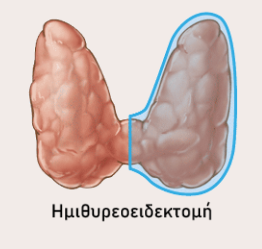
Hemithyroidectomy or lobectomy is the surgical removal of one lobe of the thyroid gland along with the isthmus. It is an operation that is performed when the disease is localized exclusively in one lobe, while the other remains healthy (in different cases, total thyroidectomyis indicated ). In this way, the damage is treated while simultaneously preserving part of the normal thyroid tissue, which in many cases prevents the need for permanent hormone replacement therapy.
Anesthesia
The operation is performed under general anesthesia. Neuromonitoringis usually used during hemithyroidectomy , which allows the identification and protection of the recurrent laryngeal nerve, minimizing the risk of voice disorders. The procedure is completely safe and painless, and the patient regains consciousness shortly after the operation is completed.
Indications
- Hemithyroidectomy is an appropriate treatment for:
- Solitary nodule with suspicious or unclear characteristics (Bethesda III–IV).
- Toxic adenoma causing hyperthyroidism.
- Unilateral multinodular goiter with pressure or aesthetic problem.
The basic requirement is the healthy function and image of the other lobe in ultrasound and laboratory testing.
Duration of surgery
The duration of hemithyroidectomy is shorter (50-80 minutes) than total thyroidectomy. The goal is not speed but the safe performance of the operation.
Preoperative hemithyroidectomy checkup
- It includes a thyroid and cervical ultrasound.
- FNA (fine needle aspiration biopsy) on suspicious nodules.
- Thyroid hormone test (TSH, T4, T3).
- Laryngoscopy to assess vocal function.
- Cardiological and anesthesiological evaluation, when necessary.
Proper preparation contributes to the safety and success of hemithyroidectomy.
Postoperative follow-up
The patient is mobilized and fed a few hours after surgery. The pain is mild to minimal, and is treated with common painkillers. In the first hours, the patient is monitored for any bleeding or swelling in the wound area. In special cases, a small drain may be placed, which is usually removed the next day.
The voice is clinically checked immediately after hemithyroidectomy, while hospitalization is usually 24 hours..
Postoperative check-up
After leaving the hospital:
- The healing of the incision and the mobility of the vocal cords are checked.
- TSH and T4 levels are monitored to assess the function of the residual lobe.
- Depending on the histological result of the biopsy (if cancer is diagnosed), additional surgical or medical intervention may be required, which occurs in a small percentage of cases.
- In most cases, permanent medication is not required.
Aesthetic effect
The incision is made low on the neck, within a natural fold of the skin, and is sutured with absorbable sutures or surgical glue. With proper care and use of sunscreen in the first months, the scar becomes almost invisible.
Advantages over total thyroidectomy
- Maintaining natural thyroid function – often without the need for thyroxine (replacement therapy).
- Minimizing the risk of hypoparathyroidism (as the parathyroid glands of the other lobe remain).
- Lower risk of laryngeal nerve damage.
- Shorter and milder recovery.
Disadvantages compared to total thyroidectomy
- Possibility of needing repeat surgery to remove the other lobe of the thyroid in case of evidence of malignancy requiring treatment with Iodine
- Greater difficulty in properly regulating thyroid hormones by the endocrinologist postoperatively.
Βιβλιογραφία
- Haugen BR, Alexander EK, Bible KC, Doherty GM, Mandel SJ, Nikiforov YE, et al. 2015 American Thyroid Association Management Guidelines for Adult Patients with Thyroid Nodules and Differentiated Thyroid Cancer. Thyroid. 2016 Jan;26(1):1–133. doi:10.1089/thy.2015.0020
- Perros P, Boelaert K, Colley S, Evans C, Evans RM, Gerrard Ba G, et al. Guidelines for the management of thyroid cancer. Clin Endocrinol (Oxf). 2014;81 Suppl 1:1–122.
- Gharib H, Papini E, Garber JR, Duick DS, Harrell RM, Hegedüs L, et al. AACE/ACE/AME Guidelines for the management of thyroid nodules. Endocr Pract. 2016;22(5):622–639. doi:10.4158/EP161208.GL
- Patel KN, Yip L, Lubitz CC, Grubbs EG, Miller BS, Shen WT, et al. Lobectomy Versus Total Thyroidectomy for Differentiated Thyroid Cancer: A Statement by the American Thyroid Association. Thyroid. 2021;31(2):155–167. doi:10.1089/thy.2020.0943
- UpToDate. Thyroid nodule: Evaluation and management. Waltham, MA: UpToDate;

Georgios Psychogios
Otolaryngologist, Head and Neck Surgeon, Professor of ENT, University Hospital of Ioannina
Contact
: 26510-72130
: orl.pgnioannina@gmail.com
Last updated: April, 2025.